A pump-and-dump scheme promotes an asset to inflate demand and price. Participants who already hold positions then sell into that demand. Buyers arriving later can be left with substantial losses.
This can involve shares or cryptoassets. Organisers do not have to be company insiders. A large price jump alone does not prove manipulation: the participants' claims, interests and actions also matter.
How does a pump and dump work?
A common combination is existing holdings, aggressive promotion and selling pressure that new buyers do not anticipate. The public story may sound like a unique opportunity while the promoters benefit from the purchases it attracts.
The CFTC warns about virtual-currency pump-and-dump campaigns, including promotions through social media and supposed inside tips. This makes the sender's identity and incentives worth examining before buying a promoted asset.
An invented example
A thinly traded token costs €1. Group messages claim a major announcement is imminent and urge people to buy immediately. In the following invented price path, it rises to €2. After heavy selling, it falls to €0.60.
Someone who bought 100 tokens at €2 and sold at €0.60 would lose, before fees:
100 × (€0.60 − €2) = −€140.
That is 70% of the €200 purchase amount. A rise from €1 to €2 does not mean a late buyer participated in that gain. Their own execution prices determine their result. Euros are used only as the example currency.
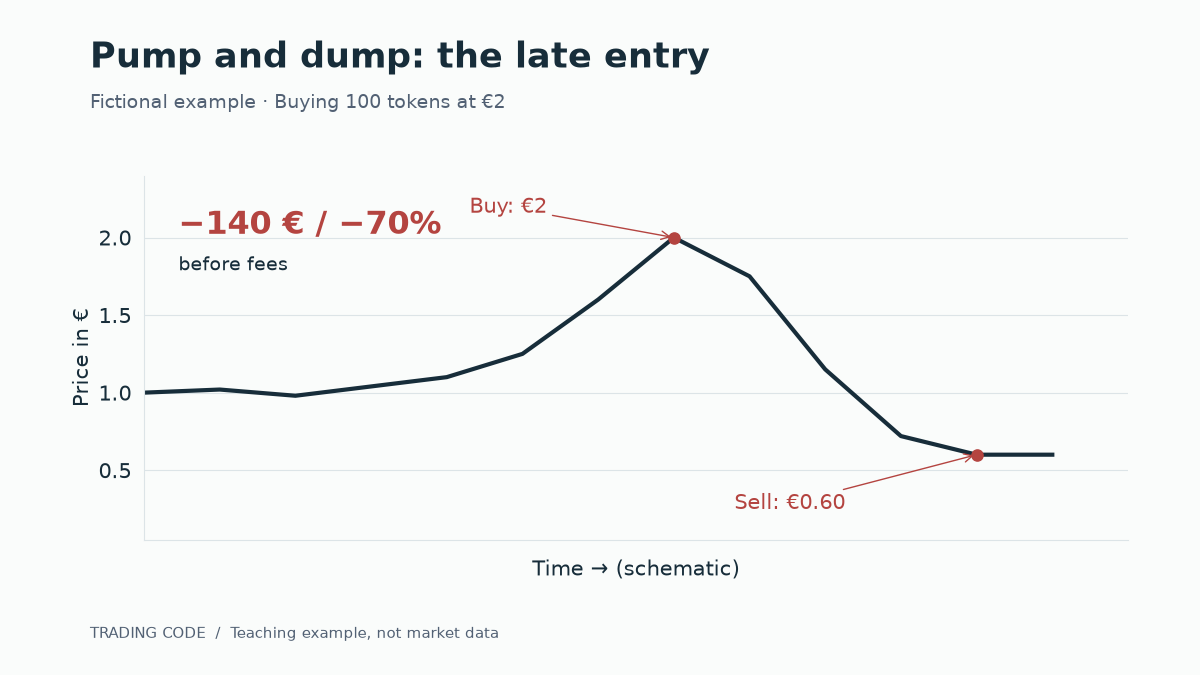
This is one possible path, not a fixed pattern. The timing, size and duration of a collapse cannot be predicted reliably. Some positions may be difficult to close at any reasonable price because demand disappears.
Warning signs to investigate
| Observation | Why it needs closer scrutiny |
|---|---|
| Guaranteed gains or a certain price multiplier | The promise ignores uncertain prices and losses |
| Urgency or a countdown to a coordinated purchase | The decision is being rushed ahead of verification |
| Supposed confidential news without a verifiable source | The claim cannot be independently substantiated |
| Profit screenshots without a complete history | Losses, deposits and open positions may be omitted |
| Unclear compensation or existing promoter holdings | There may be a financial conflict of interest |
| Limited trading and wide bid-ask spreads | Exiting can be expensive or difficult |
| An extra payment demanded to release a withdrawal | This may be another fraud attempt |
One feature is not conclusive proof. Several together are a reason to resist urgency and seek independent information.
Manipulation or an ordinary price move?
A price can rise and fall sharply because of verifiable company news, changing market conditions or ordinary speculation. Equally, an attractive chart does not establish that a promotional campaign is legitimate.
Check original announcements rather than relying on forwarded messages. For shares, company and exchange disclosures may be relevant. For cryptoassets, also understand the specific asset and the venue on which it can actually be traded.
Our chart-pattern guide helps describe a price path. It cannot replace scrutiny of the statements and interests behind a promotion.
Why planning to exit early is not protection
You cannot reliably know who bought before you, when large holders will sell or how much demand will remain when you exit. An announced selling time does not guarantee that other participants will wait.
A stop order does not remove execution risk either. A fast or illiquid market can produce a much worse price than planned. The guide to orders and costs explains the distinction. Trying to exploit suspected manipulation does not automatically put you on the winning side.
What to do about a suspicious offer
- Pause additional payments and do not share account credentials, wallet keys or recovery phrases.
- Preserve messages, timestamps, contact details, transaction identifiers and payment records.
- If payments are affected, contact your bank or payment provider through independently accessed official channels.
- Report concerns to the platform and the relevant authorities in your country. Use the official regulator or police website to find the correct reporting route.
- Be cautious of unsolicited recovery services demanding advance payment.
A general guide cannot decide whether you should sell an existing holding. Avoid basing further decisions solely on the group that promoted the asset.
How to assess a trading group
Start with clear identity, understandable rules, visible risks and transparent incentives. Ask whether results include costs, losses and the full relevant history. Membership numbers and isolated winning screenshots do not answer these questions.
The beginner trading checklist gives you a decision process of your own. Apply it even when the idea comes from somebody else. A signal does not remove your responsibility for the instrument, position size or risk.