The most useful trading tips for beginners concern decisions you can control: which setup you trade, how large the position is and when you stop. A profit target or a high win rate does not replace that process.
This guide takes you from preparation to review. If orders, positions and executions are unfamiliar, start with what a trade is.
Ten rules for your trading routine
- Learn one instrument. Understand its trading hours, minimum size, price quotation and costs before following several markets.
- Describe one setup precisely. “The chart looks good” is not a testable entry condition.
- Define what invalidates the idea. What would tell you that the market is no longer behaving as your plan requires?
- Calculate position size before placing the order. Start from a loss budget rather than a desired profit.
- Allow for execution costs. Use realistic assumptions for spread, fees and slippage.
- Write down your exit. Cover both an adverse move and a possible profitable outcome.
- Set a daily boundary. Decide when losses or rule breaches will trigger a pause.
- Check scheduled events. News can change liquidity and execution conditions.
- Record skipped opportunities too. This helps expose hindsight-driven changes to your rules.
- Review decisions separately from results. A well-executed trade can lose; a poorly planned trade can win by chance.
Position sizing: a worked example
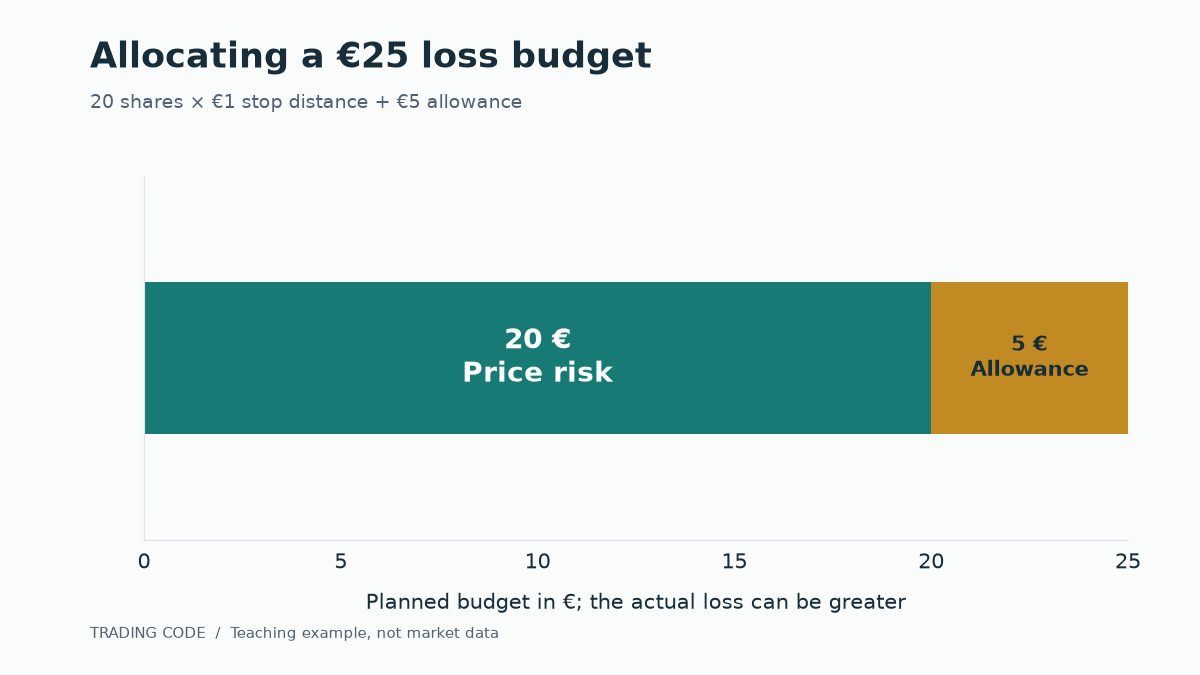
Suppose you are practising with a fictional €5,000 account. You assign a €25 loss budget, or 0.5%, to one example trade. This percentage is an assumption for the calculation, not a recommendation for your personal risk limit.
For an unleveraged share purchase, your planned entry is €50 and your stop is €49. The price distance is €1 per share. You reserve €5 in total for fees and an assumed adverse execution difference.
Number of shares = round down((loss budget − cost allowance) ÷ stop distance)
Here, (€25 − €5) ÷ €1 = 20 shares, representing €1,000 of exposure. If the position closes at the planned stop and uses exactly the allowance, the loss is €25.
The formula is a planning tool, not a loss guarantee. Futures, CFDs and foreign exchange also require the correct monetary value per point, contract size and, where relevant, account-currency conversion. If the smallest tradable unit exceeds the budget, the instrument does not fit this plan.
CME Group explains how stop distance and a loss budget affect position size. The figures above are our own simplified example.
A checklist before placing an order
| Question | Your written answer |
|---|---|
| Which setup is present? | Its name and observable condition |
| What triggers the order? | A price or event and the order type |
| What invalidates the idea? | A stop or explicit exit rule |
| What is at risk? | Quantity, price risk and cost assumption |
| What could disrupt execution? | News, limited liquidity or a technical problem |
| When do I stay out? | Exclusion rules and any daily boundary already reached |
A missing answer means the trade is not yet prepared. The day trading strategies guide shows how to turn an observation into explicit rules.
Manage your time and check events
Choose a session when you can pay attention. Schedule preparation and review as well as trading itself. Use the economic calendar and market-hours guide, then confirm your specific product's hours and holiday arrangements with the broker.
For example, a news filter might prevent new positions before selected releases. Define the filter before testing. Do not change it retrospectively just because one missed move was large.
Practise on a demo account and keep a journal
First practise order types, size calculations and closing a position. Then record a series using unchanged rules. Include the instrument, time, entry, stop, exit, costs and a screenshot.
Demo execution can differ from live execution. A simulation also cannot fully reproduce the pressure of risking money. A positive demo result is a learning milestone, not proof of future profits.
Trading psychology on difficult days
A losing trade can create an urge to recover the money immediately. A pre-agreed pause removes part of that decision from the emotional moment. Avoid increasing size impulsively to rescue the day's result.
Ask separate review questions: Was the setup present? Was the size correct? Did I follow the exit rule? The profit or loss figure cannot answer them.
Keep trading costs and tax separate
Assess strategy results after actual trading costs and before personal tax. Retain your statements. Tax treatment depends on residence, instrument and individual circumstances; moving country does not automatically make trading tax-free. Use qualified advice for decisions about your own tax position.
Your next learning step
Choose a strategy with explicit entry and exit rules and apply the checklist to example trades. For a structured learning path, see The Trading Code book. Be cautious of groups promising easy profits: our pump-and-dump guide explains warning signs.