A trade is a purchase or sale of a financial instrument, such as a share. Traders also use “a trade” to mean the complete sequence from opening a position to closing it. You enter, hold and exit. The result depends on the prices actually executed and the costs incurred.
A useful place to start is to calculate one complete trade. You do not need leverage or a price prediction to understand the mechanics.
Trade, order and position: what is the difference?
| Term | Meaning | Example |
|---|---|---|
| Order | An instruction to your broker | Buy 20 shares for no more than €50 each |
| Execution | All or part of that instruction is filled | 20 shares are bought at €50 |
| Position | Your open holding or market exposure | You now hold 20 shares |
| Closed trade | The position has been fully closed | You sell all 20 shares |
An unfilled order is not an open position. One order can receive several partial fills at different prices. You can also close a position in stages.
A worked example: buying and selling shares
This is an invented example of an unleveraged share purchase. It explains the arithmetic and does not recommend a particular trade. The euro is simply the example currency; the calculation works the same way in other currencies before conversion costs.
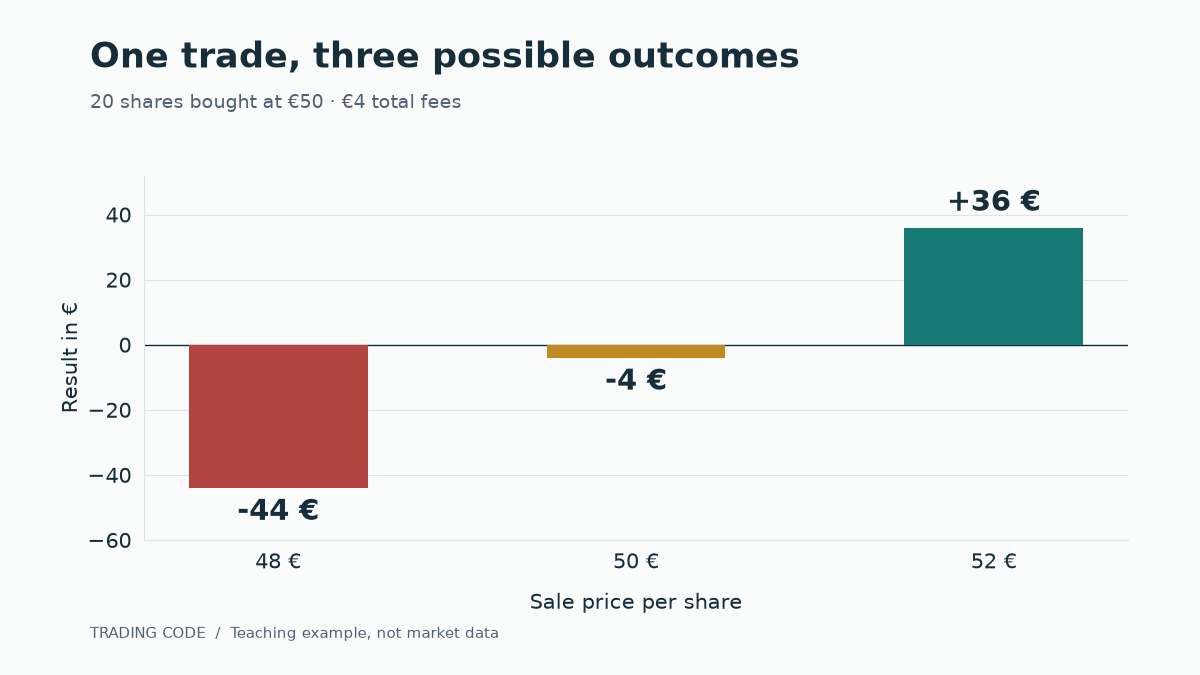
You buy 20 shares at an executed price of €50 each. Your position is worth €1,000. Later, you sell all 20 at €52.
- Price gain: 20 × (€52 − €50) = €40.
- Assumed purchase fee: €2.
- Assumed sale fee: €2.
- Result after those fees: €36, before tax and any other applicable costs.
If you sell at €48 instead, the price loss is €40 and the total loss with the same fees is €44. Selling at the original €50 still produces a €4 loss after fees. An unchanged share price does not necessarily mean a break-even trade.
What does a trade cost?
Check the fee schedule for the exact instrument and account you intend to use. Costs may appear in different places.
- Commission or order fee: a fixed or variable charge for execution.
- Spread: the difference between the quoted buy and sell prices at a point in time. Actual execution prices already reflect it, so do not subtract a generic spread again from a calculation using those fills.
- Slippage: the difference between an expected price and the executed price. It can be favourable or unfavourable.
- Other charges: depending on the product, these may include overnight financing, currency conversion or exchange fees.
“Commission-free” does not mean every aspect of trading is free. Small costs matter particularly when you are trying to capture small price moves.
Which order types should you understand?
A market order seeks execution at the available market price. A limit order sets the highest purchase price or lowest sale price you will accept, but might not fill. A regular stop order becomes a market order when its trigger condition is met; its trigger price is not a guaranteed fill. The SEC's guide explains these order types for shares. Check how your own broker implements them.
Long, short and leveraged trades
A long position benefits from a price rise before costs. A short position benefits from a price fall. The mechanism depends on the product: selling borrowed shares is different from taking a short position in a derivative.
Leverage changes the relationship between the security you provide and your market exposure. It does not remove risk. A small price movement can represent a large share of your account balance. Margin is the required security, not necessarily the most you can lose.
Trading versus long-term investing
Both can use the same instruments. Their objectives, holding periods and decision processes differ. Day traders close positions within the trading day. Swing traders typically hold for longer. Long-term investors usually make decisions around goals measured in years.
None of these labels makes an approach successful by itself. Active trading needs explicit strategy rules, a cost model and a plan for losing trades.
How to practise the process
Use a demo account or a paper worksheet. Before entering, write down the instrument, quantity, proposed entry, exit and costs. Calculate a favourable and an unfavourable outcome. Afterwards, record where expected and actual execution differed.
Then use the beginner trading checklist to make the process repeatable. A demo account helps you learn; its results do not establish that you will be profitable with real money.
Common questions
Is a trade the same thing as an investment?
A trade describes a transaction. Whether it belongs to a short-term trading plan or a long-term investment depends on your purpose and process.
Does every trade need a stop-loss?
Every trade needs a considered approach to limiting losses. A stop order can help, but a normal stop does not guarantee a particular loss amount. Position size and execution risk still matter.
How much can one trade earn?
You cannot know reliably in advance. Calculate possible outcomes including costs rather than treating a desired income as something the market must provide.
Your next step
For a structured route through the basics, visit The Trading Code book page for its contents and available editions. You can also continue with the guide to chart patterns.